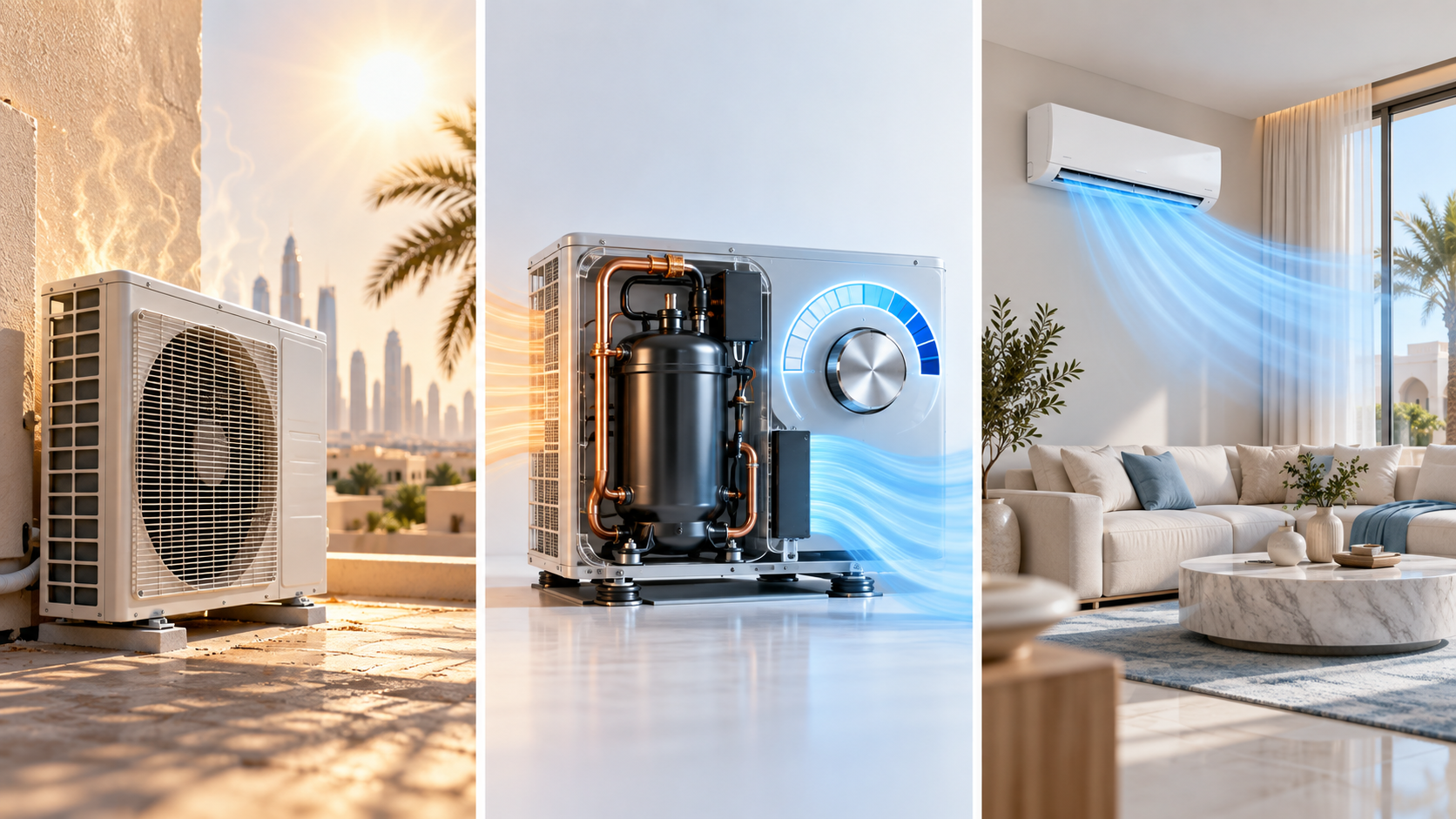
The short answer: For most GCC homes, an inverter AC is the better choice. It adjusts its cooling output as the room’s needs change, helping maintain a steady temperature while potentially using less electricity during long hours of operation.
What is the difference between an inverter and a tropical AC?
In the GCC product ranges compared here, a tropical AC is a conventional fixed-speed model designed for high outdoor temperatures. Its compressor runs at full speed when cooling is needed, switches off at the set temperature, and starts again as the room warms.
An inverter AC adjusts its compressor speed. It can cool at higher output when the room is hot, then slow down to maintain the selected temperature.
Tropical AC
Cooling pattern: Runs, stops, then restarts
Room temperature: More noticeable fluctuations
Electricity use: Runs at full compressor speed when on
Inverter AC
Cooling pattern: Adjusts output to demand
Room temperature: More consistent cooling
Electricity use: Use less power when cooling demand falls
Why is inverter technology a good fit for GCC weather?
Air conditioners in the GCC often run for many hours. Once an inverter AC has cooled the room, it can lower its output instead of continuing at full speed until it switches off. That can mean more consistent cooling, quieter operation, and lower electricity consumption than a comparable fixed-speed model. Actual savings depend on the AC, room, settings, and installation.
Can an inverter AC handle extreme summer heat?
Yes, when you choose a model designed for those conditions. Check its cooling capacity at high outdoor temperatures, including its T3 performance where available. Choosing the right capacity for your space and installing the AC properly are also essential for effective cooling.
Which should you buy?
For steady cooling and better control over electricity use, choose an inverter AC. A conventional tropical AC can provide cooling in high heat, but its fixed-speed compressor cannot reduce its output as the room’s cooling demand falls. This can result in higher electricity bills compared with a comparable inverter model. By reducing frequent start–stop cycles, inverter technology can also help limit compressor wear, although actual lifespan depends on build quality, installation, and maintenance.
Quick answers
What is the main difference between tropical and inverter ACs?
The tropical models compared here use fixed-speed compressors. Inverter models adjust compressor speed to match cooling demand.
Does an inverter AC cool well in GCC summers?
Yes, if the model is designed to perform at high outdoor temperatures and is correctly sized for the room.
How much can an inverter AC save on electricity?
Savings can reach around 50% of air-conditioning electricity costs compared with conventional fixed-speed ACs. Midea cites energy savings of 30–50% for inverter technology compared with non-inverter systems. When replacing a conventional piston-compressor AC, the actual saving depends on the models, usage, and installation.
Explore air conditioning solutions at ALSALAM
ALSALAM Electronics is Bahrain’s largest distributor of air conditioners and home appliances. Explore more than 20 international brands and a broad selection of cooling solutions, from split and window ACs for homes to cassette, ducted, package, VRF, and free-standing systems for larger properties and projects. The range includes Midea, Kastron, and Deep, with inverter and conventional options to suit different spaces and needs.
Founded in 1978, ALSALAM supports customers through a nationwide logistics and service network of more than 90 teams, providing delivery, installation, and after-sales support across Bahrain.
Browse the available sizes in ALSALAM’s Midea AC range and Kastron AC range, and find the right cooling solution for your space.